MONROE: 1860 |
|||
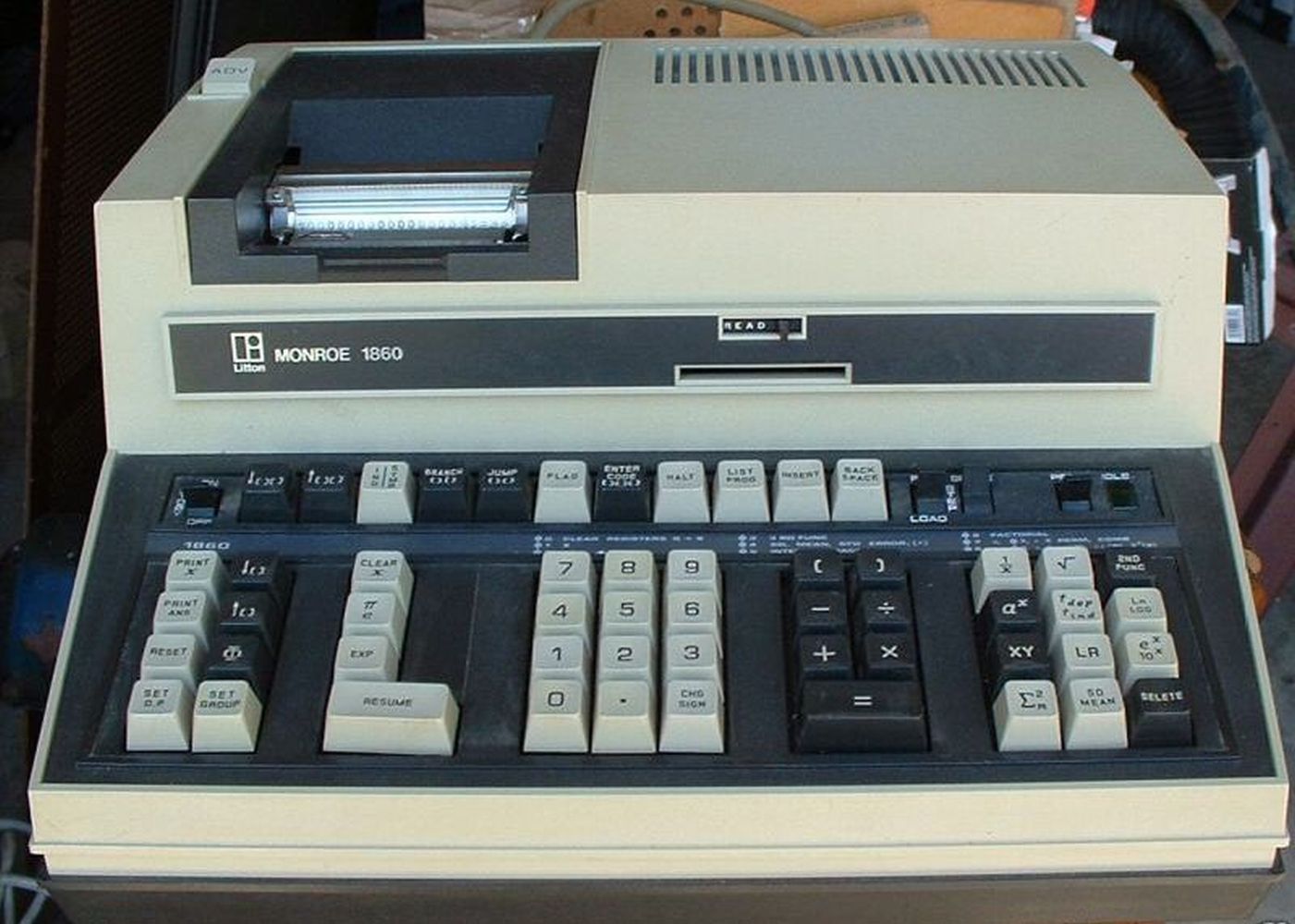
| This Calculator combines the features of a scientific/statistical calculator, extensive problem-solving capability and hard-wired keyboard functions with versatile programming commands.
The essentials are conveniently packaged in a rugged desk-top unit the size of a typewriter (with easy access I/O ports for additional system elements,) weighing 22½ lbs.
The keyboard operation is simple and straightforward, following algebraic rules of equation solving and includes two-level nesting of arithmetic operations.
By single keystroke operations, 28 mathematical and statistical functions can be provided.
The 1860 offers optional user definable keys which allow the user to address up to three programs or subroutines by one key depression.
The 1860 provides 512 program steps with additional steps as an option in increments of 512 steps up to a total of 4096.
It can handle large quantities of data in its ten scratch pad registers and 64 main data registers which are expandable in increments of 64 registers to 512.
The programming flexibility of the 1860 is further enhanced by symbolic addressing and indirect addressing techniques.
A single key makes these two techniques immediately available to the user.
There are 73 programs with 94 routines available in the Monroe statistical software library in addition to the 28 hardwired functions available on the keyboard to solve everything from single entry functions to complex problems requiring numerous data inputs such as regressions.
The software program library also includes 50 programs for Chemistry, Science and Fluid Mechanics.
Twenty-two Medical Laboratory Programs are available from Monroe including Electrophoresis and Radioimmunoassay programs.
The automatic programmable tape drive control permits more sophisticated programs to be written as overlays on pre-conditioned tapes. Large programs may be divided into a number of blocks, each holding 256 steps.
A command reads the next program or overlay of any number of blocks of memory at the appropriate locations.
The 392/1800 system permits access of over 38,000 programming steps per side of tape.
The system’s interface assembly offers both Read Only and Read/Write ports allowing the 1860 to selectively control the connected tape drives.
The tape drives may be operated manually by touching the appropriate key sequence on the 1860. The 1860 may be programmed to operate drives automatically as part of the program.
Reading and writing operations can be performed with single or dual tape cassette drives. Peripherals such as the Model 300 I/O Writer or the Model 395 Teleprinter interface can be used with the 392/1800 system, thus permitting alpha-numeric information to be written or read.
Also using the Model 395 Teleprinter interface, the Model 1860 can be interfaced with an instrument acoustic coupler, line printer, Teletype or CRT terminal and can accept or output numerical data, alpha strings of variable lengths or programs.
High-speed printed output is provided along with complete input/output peripheral capability which makes possible the use of a wide range of peripheral devices.
Keyboard operation follows algebraic rules of equation-solving, including two-level nesting of arithmetic operations.
Single keystroke generation of 28 mathematical and statistical functions is also provided. Program and data storage memories are expandable at the user’s option.
A complete repertoire of computer-like programming instructions is provided: unconditional and conditional branching, jumping, looping, subroutines.
Data may be stored and recalled under program control, and 6-level nesting of subroutines is possible.
Simplified checking and debugging procedures speed up program verification.
No special programming language is needed to write programs.
Key features:
Programmability — 512 steps in basic memory; expandable in increments of 512.
Integral magnetic card reader.
Symbolic addressing.
Program editing flexibility.
Data Storage — 10 scratch-pad registers.
64 main data storage registers; expandable in increments of 64.
Full arithmetic capability in all registers.
Direct and indirect register addressing.
Keyboard Functions:
Single keystroke generation of statistical functions.
Input/Output Capability. Algebraic Operation.
Simplicity — No need to learn computer language.
Support — Access to large and growing library on programs provided by MONROE
|